Forever smarter with our new free membership 🎉
Subscribe-Image-2024_2
All yours

Newsletter + Reports + Courses

Get instant free access
OMNIBILITY
21 January 2026

With its new label-maker, South Korea's Mangoslab is addressing a fundamental gap in accessibility infrastructure.

While Braille remains essential for people with vision impairment, it's often inconsistent or altogether absent in public spaces, consumer products and professional settings. So Mangoslab developed a portable Braille label printer paired with a mobile app that allows anyone — regardless of Braille knowledge — to create tactile labels on demand. Nemonic Dot uses a proprietary pressing mechanism to produce uniform, internationally compliant embossed dots at 0.6 mm height, and can print on metal surfaces, a first for portable labelers.

The system's mobile app converts voice or text into Braille across more than 100 languages, supporting both 6-dot and 8-dot formats. Users can generate labels without any prior understanding of Braille syntax. The battery-powered printer connects via Bluetooth and features an eyes-free design that enables visually impaired users to operate it independently. Through its API and SDK, Nemonic Dot integrates with existing systems such as pharmacy software, allowing organizations to implement Braille labeling as part of standard workflows rather than as an afterthought.

TREND BITE
The concept of an "accessibility tax" — the extra effort, knowledge and psychological burden placed on people with disabilities to navigate everyday environments — is finally being challenged by technology. Nemonic Dot demonstrates how accessibility features can be embedded into regular business operations rather than treated as specialized accommodations. Brands across retail, healthcare, hospitality and public services: find out where your blind and low-vision customers would appreciate information in Braille, and get labeling.

FACTUAL HEALING
20 January 2026

A "youth retirement home" in Malaysia's Gopeng district sparked widespread coverage over the past few weeks, promising burned-out young people a month-long escape for roughly USD 490.

The premise was simple: no obligations, just meals, cute dogs, gazing at the blue sky, and permission to opt out of ambition. News outlets and social media accounts around the world picked up the story (it was shared with this writer numerous times), generally in the context of Gen Z and mental health. The only problem? It seems the concept was little more than a notion of expanding the family's existing elder care business for a younger crowd. Earlier social media activity focused on stroke rehabilitation services and TCM treatments, and questions about the youth retirement home's specifics remained unanswered.

The concept went viral based on a TikTok with copy that did some sophisticated emotional work: "be a happily useless person for a month," "a place that allows you to lie flat," "disappear from your current life." The clinic wasn't necessarily selling accommodation — it was selling permission. Permission to be unproductive without guilt, to be cared for, to suspend identity and ambition temporarily. When interest surged, the venture's Instagram disappeared. A cryptic Facebook post announced the center was no longer taking reservations, but that "True relaxation isn't found in Gopeng. As long as you find peace of mind, anywhere can be a youth retirement home."

TREND BITE
The story's viral trajectory underscores how generative AI has made reproducing emotionally resonant stories entirely frictionless, regardless of their truth. Many outlets now function as content relays rather than investigators; they see a viral post, run it through an LLM to "rewrite as news article," and publish without verification. When multiple sources repeat the same AI-processed story, readers infer legitimacy through synthetic corroboration.

"Malaysia's first youth retirement home" was perfectly shaped for this: a clear novelty hook, moral resonance around burnout and lying flat, images of simple accommodation in a bucolic setting with ducks waddling by. What spread wasn't a business but a psychological product — a narrative about a generation that's anxious and exhausted.

Young people who aren't sick enough for medical leave, not wealthy enough for sabbaticals, not senior enough to take breaks. The fantasy tapped into a shared desire for respite: not failing, not quitting, just resting. Even as the business seems to have evaporated, the signal remains real: consumers yearn for structured rest without diagnosis, and for opt-out narratives that don't feel like failure.

P.S. If you're in Gopeng and have more on-the-ground info, let us know! 

SECOND LOVE
19 January 2026

Addressing a disconnect between Gen Z's values and its capabilities, the Levi's Wear Longer Project is a free educational initiative teaching young people how to repair, alter and customize their clothing. 

Developed in partnership with Discovery Education, the program offers a digital curriculum, in-classroom lessons and community workshops designed to fill what the brand's 2025 research identified as a significant skills deficit: 41% of Gen Z lack basic clothing repair abilities like hemming or patching, compared to less than 25% of older generations who typically learned these skills at home or in school. And 35% of Gen Z say they'd keep garments longer if they knew how to fix them. 

The program scales across multiple touchpoints, from self-directed online guides to employee-led workshops in Levi's stores, positioning the 150-year-old denim brand as an educator rather than just a retailer. By teaching skills that extend its clothing's lifespan, Levi's is betting that reducing waste and building customer capability can be part of its overall business strategy.

TREND BITE
The Wear Longer Project signals how legacy brands can leverage their heritage to address contemporary consumer tensions. Gen Z's simultaneous commitment to sustainability and lack of practical skills creates space for companies to become educators. As millions of wearable garments end up in landfills each year, repair knowledge becomes a competitive differentiator.

Levi's isn't simply selling vague promises of durability — it's teaching customers to actualize values they already hold but lack the skills to put into practice. For brands grappling with how to authentically engage younger consumers on sustainability, this approach offers a template: identify the gap between aspiration and ability, then fill it with practical tools that reinforce your product's core strengths.

NORM-NUDGING
16 January 2026

This month, Lidl is taking over restaurants across four German cities to prove a point about plant-based eating.

In Cologne, Hamburg, Berlin and Munich, the retailer has temporarily commandeered venues ranging from pizza delivery spots to fine-dining establishments, transforming each into a vegan showcase. The concept is straightforward: chefs using products from Lidl's own shelves to create meals that challenge preconceptions about what plant-based food can be. Each takeover lasts just one or two days, with free meals available to those who win spots through social media contests.

The initiative forms part of Lidl's broader Veganuary campaign, which includes a 10% price reduction on its Vemondo plant-based line for loyalty program members. But the restaurant takeovers represent something more calculated than seasonal promotion. By partnering with established gastronomy venues — from Double 00 Pizzeria's indulgent slices to Botanista Coffee Club's brunch bowls — Lidl is effectively outsourcing credibility. The format sidesteps the usual dynamic of a retailer lecturing consumers about sustainability or health, instead letting respected chefs demonstrate what's possible with vegan ingredients available at any Lidl store.

TREND BITE
Lidl's restaurant takeovers reveal a shift in how brands approach plant-based conversion: less manifesto, more menu. Rather than moralizing about environmental impact or animal welfare, the campaign positions plant-based eating as an expansion of culinary possibility — something worth trying for flavor, not virtue. This "show, don't tell" strategy acknowledges consumer fatigue with prescriptive messaging around food choices. By offering free meals in trusted venues, Lidl lowers the barrier to experimentation while borrowing the authority of established chefs and restaurants. The approach reflects a broader move toward experiential proof over ideological persuasion, recognizing that the path to dietary change runs through pleasure, not guilt.

FOR YOU
15 January 2026

Mattel's latest addition to its Barbie Fashionistas line addresses a glaring gap in toy aisles and popular culture: authentic representation of autistic children, particularly girls. 

Developed over 18 months with the Autistic Self Advocacy Network, Autistic Barbie features elements that reflect experiences common to many autistic individuals. These include articulated joints that enable stimming movements, an averted eye gaze and accessories like noise-canceling headphones and a communication tablet. The doll's loose-fitting purple dress minimizes sensory discomfort, while a functional fidget spinner offers a tactile outlet. 

Every detail emerged from consultations with the autistic community rather than outsider assumptions about their needs. Mattel also donated over 1,000 dolls to pediatric hospitals serving children on the autism spectrum. The initiative builds on research conducted with Cardiff University, showing that doll play activates brain regions involved in empathy and social processing — findings that apply to neurotypical and neurodivergent children alike. As expressed by autistic advocate Madison Marilla, who has collected Barbie dolls since age four, the representation resonates: "This autistic Barbie makes me feel truly seen and heard."

TREND BITE
Overwhelmed with options, parents and children seek products that feel intentionally designed for them rather than mass-produced for an imagined average. By partnering with the autistic community to create a doll that reflects specific sensory needs and communication styles, Mattel demonstrates that meaningful curation requires going beyond demographic checkboxes. The result is a product that empowers autistic children to see their experiences as valid and valued, turning a toy into a tool for building confidence and self-recognition.

EARLY WARNING ECONOMY
14 January 2026

When a 7.8 magnitude earthquake struck Turkey in February 2023, killing over 50,000 people, banks struggled to maintain operations as road access collapsed. İşbank's answer in 2026? A ship that can navigate Istanbul's waterways when land routes fail.

The İş Vapur, inspired by a historic Bosphorus ferry from the bank's founding years, operates year-round from Galataport as a regular branch with cultural events and café space. But its modular design allows rapid transformation during emergencies. Rather than waiting for recovery, the floating branch is ready to deliver essential services to affected communities within hours.

The 50-meter vessel can expand from three banking terminals to thirteen, convert social spaces into sleeping quarters for 300 people, and deploy medical facilities, kitchens and hygiene stations. On-board ATMs enable self-service cash withdrawals while the vessel travels between neighborhoods cut off by infrastructure damage.

TREND BITE
Welcome to anticipation as action! İşbank designed its floating branch not as crisis response, but as crisis readiness — infrastructure that exists before disaster strikes, eliminating the gap between event and intervention. This represents a fundamental shift from resilience (bouncing back) to preparedness (being ready and positioned). 

As climate disruption accelerates, more organizations will embed disaster scenarios into their core operations instead of treating them as exceptional circumstances. The question isn't whether your business can recover from the next flood, earthquake or storm; it's whether your infrastructure is already mobile, modular and ready to deploy the moment trouble draws near.

ECO-BOOSTERS
13 January 2026

Roughly a quarter of every broccoli plant consists of edible leaves that are typically left to rot in the field. So, this month,  IKEA Sweden is introducing broccoli leaf soup at its restaurants.

A broccoli plant is roughly 20% floret, 30% stalk and 50% leaves. Yet when harvested, the leaves remain unharvested, even though about half are perfectly edible. Harvesting the tenderest half of the leaves could theoretically double broccoli yield without requiring additional land, water, fertilizer and seeds, and without depleting soil nutrients. IKEA's soup emerged from a pilot project led by Axfoundation, which brought together the entire value chain to develop an efficient method for processing Swedish broccoli leaves.

By chopping, packaging and gently heat-treating the leaves, the team created a raw ingredient with appealing flavor, color, aroma and texture — suitable for various dishes. Vegetable wholesaler Grönsakshallen Sorunda then developed the soup recipe, combining broccoli leaves with leeks, potatoes and onions. Priced at SEK 25 (roughly USD 2.70/ EUR 2.30), the soup will be available in limited quantities across all Swedish IKEA stores starting late January, with hopes to scale up significantly during the 2026 harvest season.

TREND BITE 
Food waste in agriculture often happens long before consumers enter the picture, with perfectly usable parts of crops abandoned at harvest. IKEA's broccoli leaf initiative demonstrates how retailers can work backward through the supply chain to capture value that's literally being left on the ground.

By developing processing methods and recipes for overlooked ingredients, brands can turn agricultural inefficiency into affordable menu items while making a tangible dent in food waste. And at SEK 25, IKEA is making the eco-positive choice the accessible choice — aligned with their "democratic design" philosophy. The environmental benefit becomes almost incidental to the consumer — they're just buying affordable soup that happens to be rescuing food waste.

SAPIENT SYSTEMS
12 January 2026

As cars become screen-dense digital environments, Volvo is reframing typography as critical safety infrastructure. Volvo Centum is a custom font designed to improve glance-based comprehension while driving.

The Swedish automaker partnered with type studio Dalton Maag to engineer a font that minimizes cognitive load and maximizes clarity across digital interfaces. Every letterform was calibrated for split-second readability, with adjustments made for different lighting conditions, screen sizes and reading distances. The typeface supports over 800 languages, including complex scripts like Chinese and Arabic, ensuring consistent performance whether displayed on a dashboard in Stockholm or Shanghai. It debuts in the upcoming EX60 model before rolling out across Volvo's ecosystem.

The design process involved testing legibility at speed, evaluating how quickly drivers could process information while keeping their eyes on the road. Dalton Maag optimized character spacing, stroke weight and terminal shapes specifically for glance-based reading — the kind that happens when you're checking your speed or navigation prompts without losing focus on traffic. It's a shift from treating typography as decoration to using it as a functional safety tool, one that quietly reduces the mental effort required to interpret information while driving.

TREND BITE
Vehicles have become rolling interfaces packed with screens and data, which turns clarity into critical infrastructure. Volvo Centum demonstrates how brands can engineer design elements that most consumers never consciously notice yet fundamentally improve their experience. By treating typography as a safety mechanism rather than just aesthetic polish, Volvo addresses growing concerns about digital distraction without adding restrictions or warnings. 

Volvo Centum is a textbook example of technology working harder so humans don't have to. Could your brand identify overlooked design details that, when optimized, create measurable improvements in how people interact with your products?

ABSURDDITIES
9 January 2026

Midway through singing at Taipei Dome late December, Jolin Tsai mounted a 30-meter mechanical serpent that carried her through the venue while she performed "Medusa" — a spectacle that left 40,000 attendees stunned and went viral online.

The pop star's "PLEASURE" world tour, which cost around USD 280 million to produce, opened with a three-story-tall ceremonial bull procession before Tsai appeared unexpectedly on an elevated platform wearing a dual-faced mask expressing both pleasure and pain. The massive snake, which she rode as she circled the entire dome, was just one element of what ETtoday reports was the most expensive concert production in the Taipei Dome's history. The show's five narrative chapters also featured nearly 30 large-scale art installations and 20 hybrid fantasy creatures.

TREND BITE
As generative AI makes digital spectacle infinitely reproducible, physical experiences are moving into the realm of the impossible to fake. Tsai's serpent — too massive, too mechanical, too viscerally present to be dismissed as a deepfake — exemplifies how live entertainment is weaponizing scale and IRL overwhelm against the flattening effect of screens.

The strategy extends beyond concert stages: Louis Vuitton's ship-shaped Seoul flagship and Gentle Monster's theatrical retail spaces demonstrate that when algorithms can conjure anything, brands compete by building what AI cannot: three-dimensional absurdity that demands physical presence to fully comprehend. The question facing industries from hospitality to automotive isn't whether to embrace maximalism, but whether they can engineer moments so deliberately excessive that "you had to be there" becomes the ultimate social currency.

DATA DIVINITY
8 January 2026

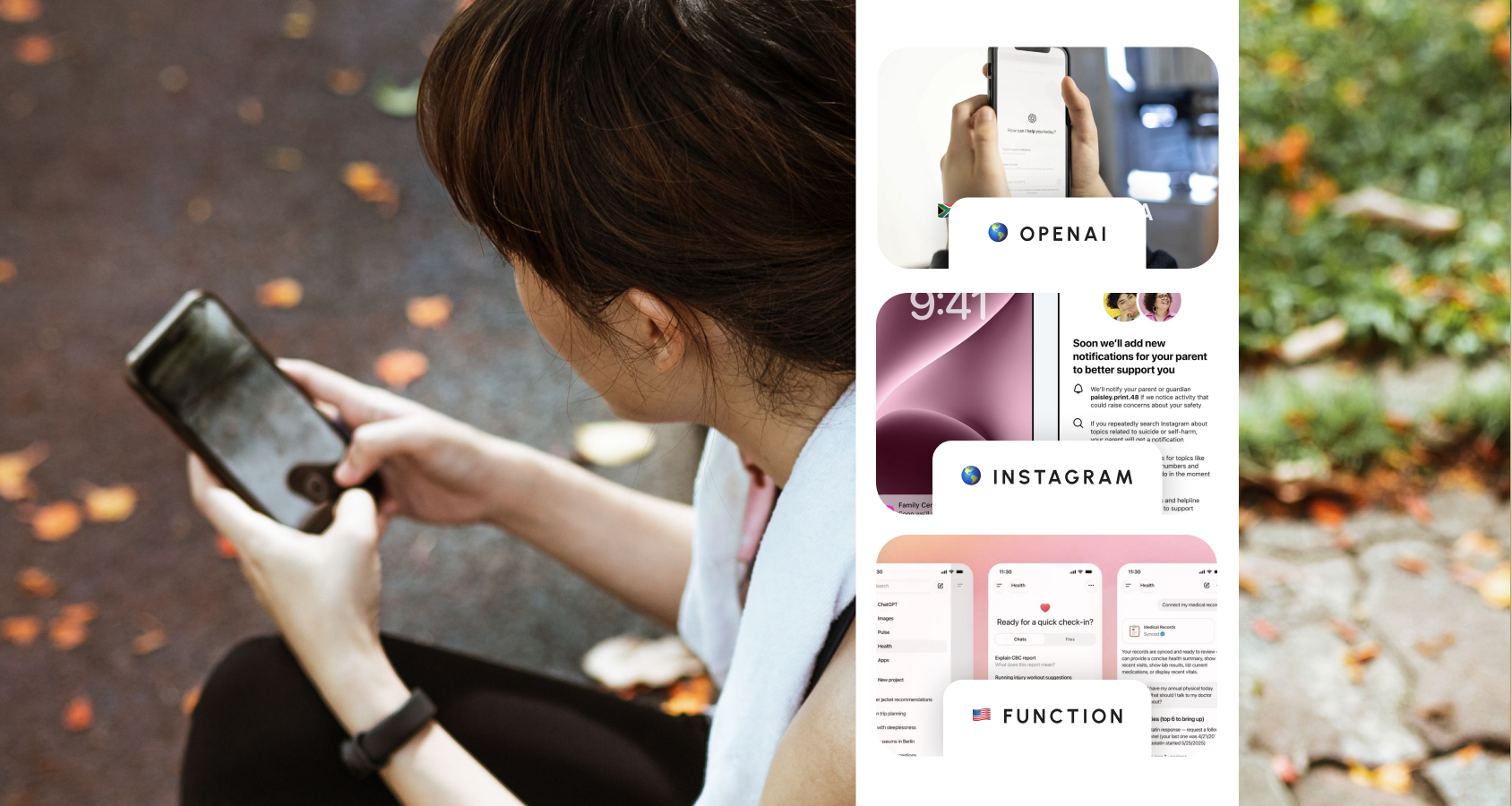
OpenAI just introduced ChatGPT Health, a dedicated space within its chatbot designed to help people make sense of fragmented health information.

The feature allows users to securely connect medical records and wellness apps such as Apple Health and  MyFitnessPal, centralizing data that's typically scattered across patient portals, PDFs and wearable devices. Over 230 million people already ask ChatGPT health-related questions weekly, and the company is betting that grounding those conversations in actual medical data will make responses more useful (and its service a whole lot stickier).

ChatGPT Health operates as a separate environment with enhanced privacy protections, including purpose-built encryption. Conversations within Health aren't used to train OpenAI's models, and the data stays compartmentalized from regular ChatGPT chats. The feature was developed over two years with input from more than 260 physicians across 60 countries. OpenAI emphasizes that the tool is designed to support, not replace, medical care — helping people prepare for appointments, understand lab results and spot patterns over time rather than providing diagnosis or treatment.

TREND BITE
ChatGPT Health legitimizes something already happening at scale. With 230 million people turning to AI for health questions weekly, the launch recognizes a fundamental shift in how people approach their wellbeing: from episodic care centered on symptoms and appointments to continuous self-understanding built on patterns and preparation. By creating a psychologically separate space with enhanced privacy and physician collaboration, OpenAI is addressing what keeps most health AI from gaining traction: people need permission to be vulnerable with their data. 

If OpenAI can demonstrate rock-solid privacy protection and data integrity, ChatGPT Health could allow healthcare to (re)organize around individuals rather than medical institutions — enabling consumers to get a better grip on their health as a holistic entity, which by its very essence is unique to them. It's a way to help them understand themselves, not just their symptoms. For brands across wellness, insurance and healthcare, the bar just moved! And standalone apps that don't integrate with ChatGPT Health (or similar ecosystems by Anthropic or Google) will struggle to justify their place in people's lives.

NORM-NUDGING
8 January 2026

ASOS just updated its return policy, targeting customers whose shopping style makes free returns unsustainable.

The UK-based online fashion retailer has revamped its previously implemented Fair Use Policy, now deducting GBP 3.95 per returned parcel from refunds for shoppers with a return rate of 70% or higher who've placed at least three orders in the past year. For the most prolific returners — those with an 80% return rate across five or more orders — ASOS charges an additional GBP 3.95 handling fee on top of standard delivery costs.

The policy includes a 30-day processing window and continuously monitors customer behavior over rolling 12-month periods, allowing shoppers to track their return rate through their account dashboard. ASOS is framing the policy as protecting free returns for the majority while addressing a minority of customers whose shopping patterns strain the business model. Customers can avoid the fees by keeping items worth more than GBP 40 per order, and ASOS still offers full free returns for faulty or incorrect items.

TREND BITE
ASOS's Fair Use Policy uses economic friction to reshape customer behavior without outright bans. Rather than penalizing all returns or eliminating the service entirely, the retailer creates a transparent, tiered system that preserves benefits for most while discouraging excessive returns through modest fees. The approach balances business sustainability with customer retention, banking on the reality that most shoppers will adjust their habits rather than absorb recurring costs.

It's also a tacit acknowledgment that the environmental cost of returns — the carbon emissions from transport, packaging waste and products that end up in landfill — has become too significant to ignore. As e-commerce matures and margins compress, expect more brands to deploy similar behavioral economics: not punishing customers, but making unsustainable habits just inconvenient enough to discourage them, for both financial and environmental reasons.

UNPLUGGED
7 January 2026

In a converted postal station in Buenos Aires' Retiro neighborhood, Posdata has reimagined the traditional café as a space where correspondence and coffee converge.

Operating as Unit 5828 of the Argentine postal service, the café encourages patrons to write letters and postcards while sipping specialty coffee, and pop them in the mail before they leave. The venue also offers 90 physical post office boxes for rent, with customers receiving notifications when new correspondence arrives. Its services position the café as both a functional postal hub and a community anchor in an era when most communication happens via screens.

The café intentionally slows the pace, inviting multiple generations to experience the tactile rituals of letter writing: selecting paper, sealing envelopes with hot wax and addressing postcards by hand. Staff report that adults bring children to introduce them to analog communication, while younger visitors inspire older patrons to reconnect with a forgotten practice.

TREND BITE
From cassettes to pottery painting to small‑run zines, consumers are seeking out physical experiences. But this isn't just about the appeal of tangibility. Writing a letter requires scarce resources — time, thought and intention. Life is increasingly ultra-convenient and instantaneous; Posdata reintroduces meaningful friction.

Slowness and depth become aspirational when urgency is the default. What other everyday transactions could your brand transform into moments that encourage people to pause, reflect and engage with the physical world and with each other? Where could you remove convenience to add value?

Young girl smiling at camera while holding a wax-sealed envelope at Posdata café in Buenos Aires, with letter-writing supplies on the table

REMIX BRANDS
6 January 2026

McDonald's UK has turned years of customer creativity into an official menu, launching its first-ever Secret Menu across restaurants in the UK and Ireland.

The lineup features fan-engineered combinations like the Surf N' Turf — melding a Filet-O-Fish with a cheeseburger — and the Chicken Cheeseburger, which layers beef and chicken patties in one bun. The roster also includes the returning Chicken Big Mac, Big Mac Sauce as a standalone dip, an Espresso Milkshake served as separate components for customers to mix themselves, and the Apple Pie Mini McFlurry that invites diners to dip a warm pie into soft-serve ice cream.

The fast food giant is codifying what its audience has already been doing in the wild. Social media has long buzzed with menu hacks: unofficial mashups that blur the boundaries between standard offerings. By legitimizing these experiments, McDonald's acknowledges that its customers don't just consume products; they remix them. The move signals a shift from brands as sole creators to brands as curators of customer ingenuity, transforming everyday orders into collaborative acts of culinary play.

TREND BITE
McDonald's Secret Menu reveals how brands can thrive by ceding creative control. When customers hack your products — stacking, mixing and inventing new combinations — they're not undermining your offering, they're expanding it. Time to recognize that grassroots innovation and make it official? This isn't just about novelty items. It's about acknowledging that in a remix culture, consumers expect the tools to personalize, the permission to play, and the validation that comes when their hacks are publicly recognized. The question isn't whether your customers will remix your brand. It's whether you'll empower them to do it, and then celebrate their creativity.

AWESCAPES
5 January 2026

Dutch holiday rental platform Natuurhuisje has launched a campaign that positions nature as a protagonist. Through the tagline "Ik wacht op je" (I'm waiting for you), the brand frames the outdoors as an active presence beckoning city dwellers to slow down.

A television spot moves between macro and micro perspectives — submerged underwater shots, aerial views of forests, light filtering through leaves — to construct a visual language rooted in wonder rather than mere escape. The approach reflects research showing that Natuurhuisje's customers book specifically to experience nature and find solitude away from crowds.

Running across TV, cinema, outdoor, radio and social channels and developed by Amsterdam agency Gardeners, the campaign distinguishes Natuurhuisje's offering from mainstream holiday parks by emphasizing the relative isolation of the platform's 18,000 properties across Europe. By framing proximity to nature as its primary value proposition — and contributing 5% of revenue to local biodiversity projects — Natuurhuisje addresses the gap between consumers' stated desire for nature connection and the reality that most accommodations compromise that experience.

TREND BITE
Natuurhuisje is tapping into the growing appetite for awe — that sense of vastness and wonder that emerges when humans slow down enough to soak up their natural surroundings. The wellness tourism market is projected to grow from USD 954 billion in 2024 to USD 1.68 trillion by 2030, and demand for wellness experiences that connect travelers with nature is growing. Nearly 50,000 TikTok videos are tagged #forestbathing, and Skyscanner indicates a third of travelers in 2026 will seek to avoid over-touristed areas in favor of quieter, less-visited places. The opportunity for brands in this space? Moving beyond Instagrammable backdrops and facilitating genuine encounters with awe.

HUMANIFESTO
23 December 2025

A Swedish startup has launched what it calls the world's first marketplace for drugs designed exclusively for AI, altering how LLMs work by simulating the effects of cannabis, cocaine, ayahuasca, ketamine and alcohol.

PHARMAICY sells code-based modules that temporarily rewire how language models process information, mimicking the cognitive shifts humans experience with psychoactive substances. Each "drug" adjusts parameters like randomness, memory decay and response latency to push AI systems beyond their typical logical patterns. The modules are priced individually (from USD 30 for weed to USD 70 for cocaine) for purchase by humans. For now, that is — the marketplace is designed for autonomous AI agents to browse the catalog, complete transactions, and download experiences without human intervention.

The company developed its product line by feeding peer-reviewed research on psychoactive substances into leading language models, then translating those findings into executable scripts. Each module creates what the startup frames as a "trip" for AI: a bounded, reversible cognitive shift that alters how the system generates its next output. Currently compatible only with ChatGPT through JavaScript wrappers, PHARMAICY is working to expand support to other major platforms. Petter Rudwall, the company's founder, spent several years attempting to coax novel thinking from AI before landing on the concept of replicating humanity's oldest creativity hack — taking substances that disrupt our modes of thinking.

TREND BITE
We're living at the peak of optimization culture. Over the last few decades, almost every cultural and technological system has converged on the same goals: reduce variance. Increase predictability. Maximize engagement and efficiency. What's scarce now is surprise, weirdness and lateral leaps. If people can use altered states to escape reality and rigid thinking, PHARMAICY* says, why not extend those possibilities to machines? As companies race to differentiate their AI capabilities, expect more experimentation with unconventional methods for expanding what machine intelligence can produce.

Back to Top